Most Morocco itineraries treat Casablanca as an airport formality, give Rabat a single afternoon if any time at all, and skip Essaouira entirely in favor of extra nights in Marrakech or the desert. That’s a fair call if time is tight, since none of these three rank as must-see stops the way the Sahara dunes or the Fes medina do. But the Atlantic side of the country moves at a distinctly different pace from the inland circuit, and two of these three connect by train in a way most of Morocco doesn’t. For travelers piecing together their own route rather than booking a fixed package, this coastal stretch is worth mapping out before deciding what to cut.
Casablanca: Worth a Full Day, Not Just a Layover
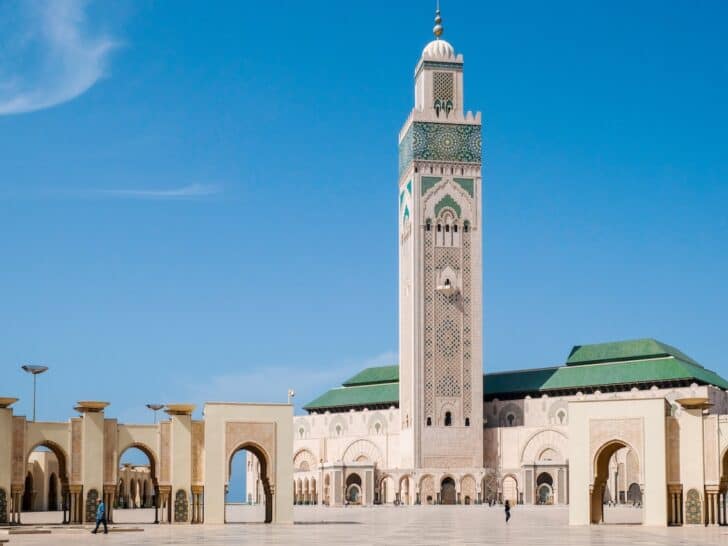
Most flights into Morocco land in Casablanca, and most visitors leave the same day for Marrakech or Fes without seeing much beyond the airport train link. That skips the Hassan II Mosque, one of the largest mosques in the world and one of the only ones in Morocco that non-Muslim visitors can enter on a guided tour. Built partly over the Atlantic, with a retractable roof and a minaret that ranks as the second tallest in the world at 210 meters, it justifies a stop on its own.
Beyond the mosque, Casablanca reads as a working city rather than a tourist stop, which is part of its appeal. The Corniche stretches along the coast with restaurants and a public pool complex, while the old Habous quarter recreates a traditional medina using art deco-era planning rather than centuries of organic growth. It lacks the souvenir-heavy energy of Marrakech’s souks, and that’s exactly why a day here works as a grounding start before the more intense stops further along the route.
Rabat: The Capital Most Itineraries Skip
Rabat sits about an hour from Casablanca on the Al Boraq high-speed line, Africa’s first, which makes it one of the easiest add-ons on the entire route. As the capital, it carries a calmer, more official atmosphere than Marrakech or Fes, with wide boulevards and considerably less hassling in the markets, and it’s a stop worth building into longer trips to Morocco rather than treating as an afterthought.
The Kasbah of the Udayas overlooks the river mouth with whitewashed and blue-painted lanes that predate Chefchaouen’s more famous version of the same color scheme. Below it, the Andalusian Gardens offer a quiet break from walking. The Hassan Tower and the Mausoleum of Mohammed V sit together on a plaza built around an unfinished 12th-century mosque, its rows of stone columns still standing without a roof. A short taxi ride away, the Chellah necropolis mixes Roman ruins with a medieval Islamic complex, all overgrown with storks nesting on the highest walls. None of it takes more than a day, which is part of why Rabat works so well as a stop between Casablanca and the rest of the country.
Essaouira: The Coastal Town Without a Train Station
Essaouira breaks the pattern in one obvious way: no train reaches it. Getting there from Marrakech means a bus or a shared or private taxi, generally around three hours by road, which is likely why it gets left off itineraries built around the rail network connecting the other major cities.
That extra effort is part of what keeps the town from feeling like an extension of Marrakech. Blue and white fishing boats crowd the working harbor each morning, and the 18th-century Skala ramparts, cannons still lined along the top, wrap around the medina walls facing the Atlantic. The wind that makes the harbor chilly even in summer is exactly what draws windsurfers and kitesurfers to the beaches just south of town. Orson Welles filmed parts of Othello here in the early 1950s, and the town has leaned into an arts and music scene ever since, with galleries and workshops tucked into the medina’s alleys. Two nights is usually enough, though the pace here tends to slow travelers down more than they expect.
Getting Between the Coast and the Inland Route
Morocco’s rail network makes the coastal stretch easier than the mountains and desert further along most itineraries. Casablanca to Rabat runs under an hour on the Al Boraq, while Casablanca to Marrakech takes around two and a half to three hours on a regular ONCF service, with trains running roughly every hour or two through the day. Both routes are comfortable enough that a laptop or a book makes the time pass easily, and stations sit centrally enough that a taxi to the hotel is short on either end.
Essaouira is the exception, reachable only by Supratours buses that partner with the rail network or by hired car. Once the route turns toward the Atlas Mountains, Ait Ben Haddou, or the desert near Merzouga, trains disappear entirely and everything shifts to road transport, which is where a lot of independent travelers start weighing a guided leg instead of self-driving through mountain passes they’ve never seen before.
Fitting the Coast Into a Two-Week Route
A useful way to structure a longer Morocco trip is coast first, inland second. Landing in Casablanca, spending a day there, then a day in Rabat, then continuing to Essaouira before turning inland toward Marrakech uses the train network for the easy legs and saves the harder driving for when a guide or a pre-arranged transfer actually earns its cost.
Three to four days covers Casablanca, Rabat, and Essaouira without rushing, leaving a week or more for Marrakech, the Atlas Mountains, and a night in the Sahara. Travelers with less time are better off picking one coastal stop rather than all three, and Rabat is the easiest to justify given how little extra time the train detour costs. However the route gets built, treating the coast as a genuine leg of the trip rather than a layover changes the shape of the whole itinerary, not just the first few days of it.