
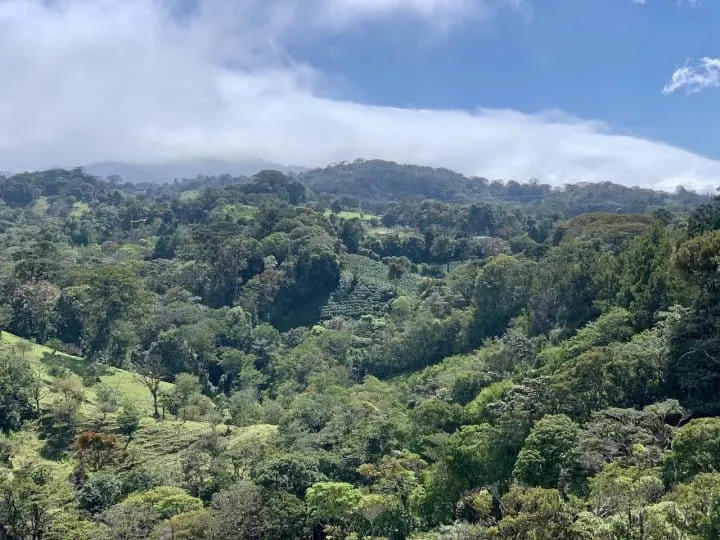
Costa Rica covers about 51,000 square kilometres, roughly the size of West Virginia, and more than 900 bird species have been recorded within it, alongside sloths, four species of monkey and one of the densest amphibian lists anywhere. The number that matters more for planning, though, is elevation. The country climbs from sea level to over 3,800 metres and has two coasts with completely different rainfall patterns. Wildlife can change entirely in a two-hour drive. Building an itinerary around that gradient, rather than around one famous destination, is what separates a varied wildlife trip from a repetitive one.
Arenal and the northern lowlands
The area around Arenal Volcano sits at the transition between lowland rainforest and foothill forest, which is why the species list here is so long. Early mornings on the trails near the Arenal Observatory Lodge or along the Peninsula Road toward the lake regularly produce Keel-billed and Yellow-throated Toucans, Montezuma Oropendolas working their pendulous nests, and, with some luck, Great Curassow moving through the understorey. Howler monkeys are almost always heard before they are seen, usually well before dawn.
What makes Arenal efficient is the concentration. You can walk secondary forest, old lava flow scrub and lakeshore edge within the same morning, and each holds different species. Most lodges in the area maintain feeders that pull in tanagers and honeycreepers at close range, which is useful if you are travelling with people who are curious about wildlife but not willing to stand still for an hour.
Cano Negro and the northern wetlands
Two hours north of Arenal, the landscape changes completely. Cano Negro Wildlife Refuge is a seasonal wetland with over 300 recorded bird species, and it is the most reliable place in the country to look for Jabiru, the tallest flying bird in the Americas at up to 1.5 metres. The dry season, roughly December through April, is the window: as water levels drop, fish concentrate, and the birds concentrate with them. It is also when Jabiru build their nests in the tallest trees of the wetland.
Cano Negro is boat country. Most visits are done from a small boat on the Rio Frio, which gets you close to roosting waterbirds, caimans and river turtles without disturbing them. It is a half-day trip from La Fortuna and one of the better-value excursions in the region.
Monteverde and the highlands
Monteverde’s cloud forest is cooler, wetter and considerably quieter than the lowlands. The species you come for are different and so is the pace. The Resplendent Quetzal is the headline: breeding runs from mid-February into June or July, timed to the fruiting of wild avocados and other trees in the laurel family, and March through June is the most reliable stretch.
The Three-wattled Bellbird overlaps with that window, present around Monteverde from roughly March through September. Its call is genuinely startling the first time, a metallic clang that carries across ridgelines. Hummingbirds are abundant year-round and unusually approachable at the garden feeders.
One practical warning: visibility in cloud forest depends entirely on cloud. A single morning is a coin flip. Give Monteverde two, ideally three, and start early, because the cloud typically builds through the day.
The Caribbean lowlands
The Sarapiqui region and the forest running north and east toward Tortuguero hold species you will not find anywhere in the highlands. This is Great Green Macaw country, one of the last strongholds for a critically endangered parrot, and it is also where Great Potoos roost through daylight hours pressed motionless against broken branches, indistinguishable from the wood until they open their eyes.
The tanager and manakin diversity here is the highest in the country. It is also worth planning for night: a large share of the activity in Caribbean lowland forest is nocturnal, and a guided night walk turns up frogs, snakes, kinkajous and owls that simply are not available during the day.
The Osa Peninsula and the south Pacific
Osa is the most demanding region to reach and the one most people wish they had given more time. Corcovado National Park holds the largest remaining block of Pacific lowland rainforest in Central America, with Scarlet Macaws in numbers you will not see elsewhere, all four Costa Rican monkey species, tapir and, for the very lucky, tracks of big cats.
Further north along the same coast, the area around Uvita and Marino Ballena adds a marine layer to the trip: humpback whales pass through in two seasons, roughly July to October and again December to March, and the coastal forest behind the beaches holds Fiery-billed Aracari and Baird’s Trogon, both largely restricted to this corner of the country.
Going alone or with a guide
Self-driving works well for landscapes, for hot springs and for the easier, more visible wildlife. Sloths, coatis, howler monkeys and toucans do not require an expert. For birds specifically the calculation changes. A good local guide knows which fruiting tree is active this week, can identify a call before you have located the bird, and carries a scope that turns a distant silhouette into a species. The difference on a day list is not marginal. Operators specialising in Costa Rica birding tours build routes that deliberately connect highlands and lowlands within one trip, so the habitat keeps changing rather than repeating for a week, and the guides are typically Costa Rican naturalists who have worked the same sites for years.
If the budget only stretches to one guided day, spend it in cloud forest. That is where the gap between guided and unguided is widest.
When to go
December through April is the dry season: easier driving, more predictable mornings, higher prices and more people. May through November brings rain, usually as afternoon downpours rather than all-day drizzle, along with more animal activity, greener forest, fewer visitors and noticeably lower rates. September and October are the wettest on the Pacific side but among the best on the Caribbean.
For wildlife rather than beach weather, the green season is often the better trade.
Practical notes
Bring binoculars, one pair per person, and accept that mornings start early: most forest activity happens in the first three hours of light and tapers sharply by mid-morning. Waterproof footwear with grip matters more than hiking boots. And build in slack. The single most common mistake on a Costa Rica itinerary is scheduling four regions into ten days and spending most of them on the road.